Technology investment is accelerating at an unprecedented pace. In 2024, 61% of organizations increased their IT budgets, while 92% planned to adopt AI-driven solutions, according to Gartner. This surge is global and ongoing, with worldwide IT spending projected to reach $5.6 trillion.
For business leaders, the challenge is no longer whether to invest in technology—but where to invest to remain competitive, resilient, and future-ready.
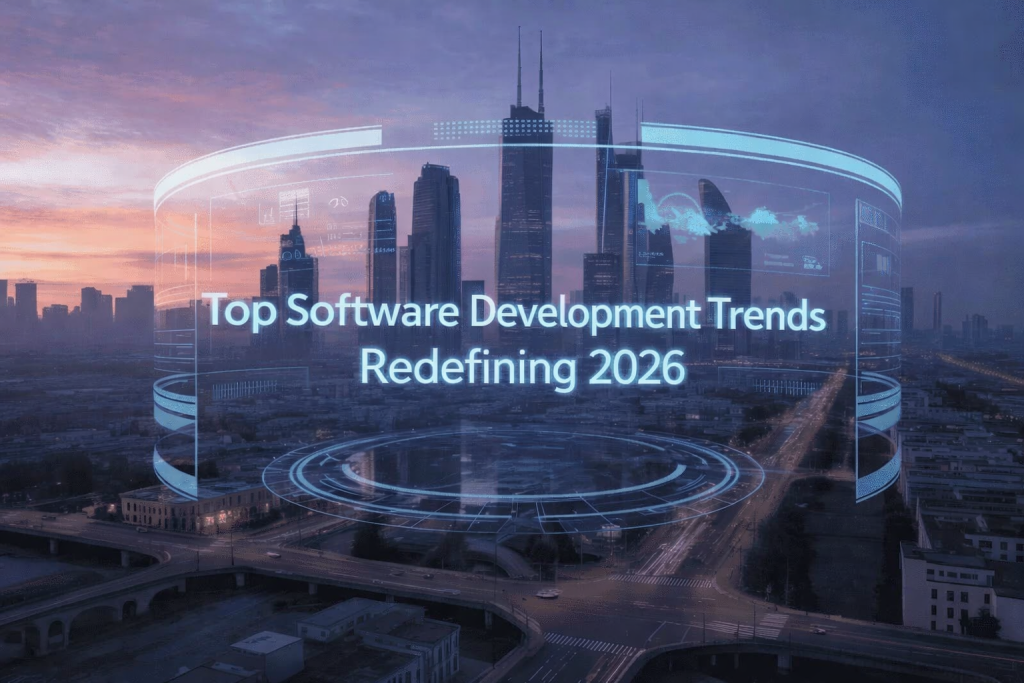
This article explores the most influential software development trends shaping 2026, highlighting how emerging technologies are transforming product development, operational efficiency, and customer experience.
Why 2026 Marks a Strategic Shift in Software Development
By 2026, software development will undergo a fundamental transformation. Advances in artificial intelligence, cloud-native architectures, automation, and edge computing are redefining how digital systems are designed, delivered, and scaled.
These technologies are not just improving efficiency—they are reshaping collaboration models, compressing release cycles, and raising expectations for speed, personalization, and reliability.
1. AI Evolves into an Essential Development Partner
Artificial intelligence is transitioning from an optional enhancement to a core component of daily development workflows. Today, 84% of developers already use or plan to use AI tools, with more than half relying on them every day.
Solutions such as GitHub Copilot, Claude Code, Cursor, and Windsurf act as intelligent co-developers—supporting code generation, debugging, refactoring, test creation, documentation, and architectural planning. Modern AI systems are multimodal, capable of understanding code, text, and voice, enabling teams to deliver higher-quality software in significantly less time.
As a result, development cycles that once spanned months can now be completed in weeks, allowing organizations of any size to innovate at scale.
2. Cloud-Native Architectures Enable Distributed Workforces
The rise of hybrid and remote work has made cloud-native systems indispensable. Nearly one-third of enterprises now invest over $12 million annually in public cloud platforms, reflecting the strategic importance of scalable infrastructure.
Organizations are rapidly moving away from on-premises environments in favor of microservices, containerized deployments, serverless computing, and cloud-based CI/CD pipelines. Platforms such as AWS, Microsoft Azure, and Google Cloud enable continuous delivery, global availability, and operational resilience across time zones.
3. Low-Code and No-Code Accelerate Business-Led Innovation
Low-code and no-code platforms are democratizing application development by enabling non-technical teams to build digital solutions independently. Finance teams can create internal tools, HR departments can automate onboarding, and marketing teams can launch campaign microsites in days instead of months.
Gartner forecasts the low-code market will reach $44.5 billion by 2026. To ensure security and scalability, platform engineering teams provide governance frameworks, standardized APIs, version control, and automated compliance checks across all applications.
4. Cybersecurity Automation Becomes a Foundational Requirement
As cyber threats grow more sophisticated, security has become a top priority. In 2023, 59% of organizations experienced ransomware attacks, underscoring the need for proactive defense.
By 2026, enterprises rely heavily on AI-driven security automation to identify, analyze, and neutralize threats in real time. Security controls are now embedded directly into development pipelines, enabling continuous vulnerability scanning, policy enforcement, and risk mitigation before software reaches production.
5. Quantum Computing Transitions from Research to Enterprise Trials
Quantum computing is beginning to move beyond experimentation into early enterprise adoption. With market projections ranging between $450 and $850 billion over the next 15 years, organizations are exploring quantum solutions for optimization, cryptography, and advanced simulations.
Cloud-based quantum platforms allow developers to test quantum workloads without specialized hardware, unlocking new possibilities in areas such as drug discovery, supply chain optimization, and complex financial modeling.
6. IoT Ecosystems Deliver Real-Time Operational Intelligence
By the end of 2024, an estimated 18.8 billion IoT devices were connected globally, generating continuous streams of data.
Enterprises leverage IoT platforms to improve asset performance, anticipate maintenance needs, and support data-driven decision-making. The IoT market is expected to grow from $21.5 billion in 2025 to $41 billion by 2030, reinforcing its role as a cornerstone of digital transformation.
7. DevOps and CI/CD Drive Continuous Software Delivery
DevOps practices and CI/CD pipelines have become essential for modern software teams. A 2024 analysis found that 32.7% of GitHub repositories actively use CI/CD workflows.
By 2026, release cycles will shrink dramatically—from weeks to hours. Automated testing, deployment, and monitoring enable organizations to innovate rapidly while maintaining system reliability and performance.
8. Internet of Behavior Powers Intelligent Personalization
The Internet of Behavior (IoB) combines data from applications, devices, and sensors to analyze user behavior in real time. These insights allow businesses to deliver personalized experiences, offers, and recommendations at scale.
The IoB market reached $432.2 billion in 2023 and is projected to grow at more than 23% annually through 2032, driven by advances in AI and analytics.
9. FinOps and GreenOps Align Financial and Environmental Goals
As cloud usage expands, organizations are integrating FinOps to control costs and GreenOps to reduce environmental impact.
Together, these practices provide visibility into cloud spending and carbon emissions, enabling more responsible and sustainable software development aligned with corporate ESG goals.
10. AR and VR Expand Enterprise Innovation
Augmented and virtual reality technologies are increasingly adopted across enterprise use cases, including workforce training, healthcare, manufacturing, and design.
Global AR/VR revenue is expected to reach $46.6 billion by 2025, with augmented reality leading adoption. By 2026, integration with edge computing and web-based platforms will deliver faster, more immersive experiences.
Conclusion
By 2026, these software development trends will move from emerging concepts to business-critical capabilities. Organizations that embrace AI-driven automation, cloud-native architectures, security-first development, and sustainable practices will be best positioned to lead in an increasingly digital economy.
At Intelegain, we help enterprises translate these trends into practical, scalable solutions—from modernizing legacy systems to embedding AI into mission-critical workflows.
- By admin